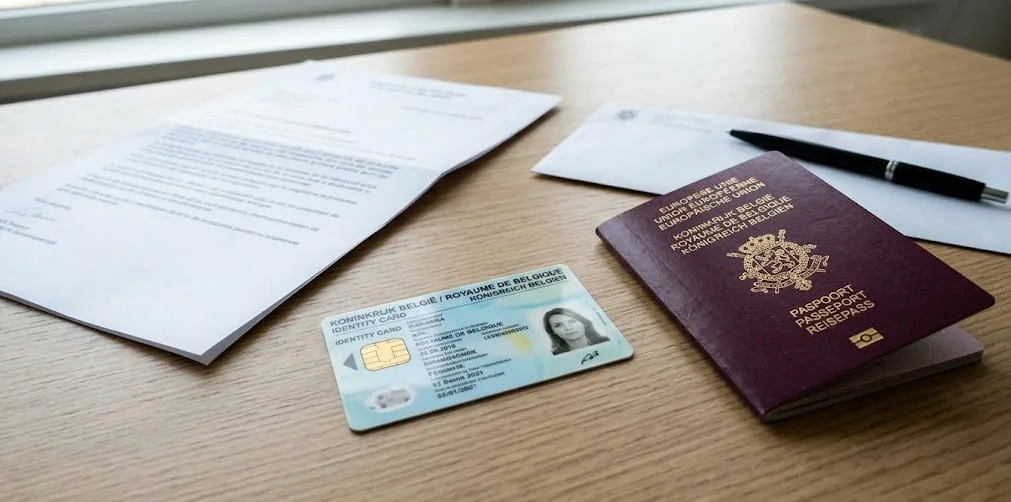
The single permit (gecombineerde vergunning) combines work authorisation and residence into one application for non-EU employees. We manage the full process for employers and employees.
The single permit (gecombineerde vergunning/permis unique) is Belgium's combined work and residence permit for non-EU employees staying longer than 90 days. Introduced in 2019 to implement EU Directive 2011/98/EU, it replaced the previous two-step process (work permit B + D visa) with a single, streamlined application. LawSupport assists both Belgian employers and international employees with the complete single permit process.
How the Single Permit Works
The single permit is a one-stop-shop — one application covers both work authorisation and residence:
Work component — assessed by the regional employment authority (Brussels, Flanders, or Wallonia)
Residence component — assessed by the Immigration Office (DVZ/OE)
Both run in parallel — the regional authority forwards the residence component to DVZ/OE automatically
One result — the employee receives a single A card (residence card with work authorisation)
Who Needs a Single Permit?
A single permit is required for non-EU/EEA employees who will work in Belgium for more than 90 days. This includes:
Employees hired by a Belgian company
Intra-corporate transferees (ICT) for stays > 90 days
Highly qualified workers (alternative to EU Blue Card)
Seasonal workers for stays > 90 days
Researchers with a hosting agreement
EU/EEA/Swiss citizens do NOT need a single permit — they have automatic right to work. For self-employed activities, a professional card is needed instead of a single permit.
Application Process
1
Employer Files
Application to regional authority
→
2
Dual Review
Work + residence assessed in parallel
→
3
Decision
Approval notification to employer
→
4
D Visa
Employee applies at Belgian embassy
→
5
A Card
Commune registration + residence card
Step 1 — Employer Files Application
The Belgian employer submits the application to the competent regional employment authority. Required documents:
Application form (region-specific)
Employment contract (signed by both parties, specifying salary, function, duration)
Employee's passport copy
Employee's qualifications (diplomas, professional certificates)
Labour market test evidence (if required — job postings via VDAB/Actiris/Forem)
Employee's criminal record certificate (apostilled, translated, max 6 months old)
Medical certificate
Step 2 — Parallel Processing
The regional authority assesses the work component (labour market test, salary, employment conditions) while DVZ/OE assesses the residence component (security, admissibility). Both run simultaneously. The regional authority has a legal deadline of 4 months to issue a decision from the date of a complete application.
Step 3 — Decision
If approved, the regional authority issues a positive work authorisation decision and DVZ/OE approves the residence component. The employer and Belgian embassy are notified.
Step 4 — D Visa Application
The employee applies for a long-stay D visa at the Belgian embassy/consulate in their country of residence. Documents: approved single permit decision, passport, medical certificate, proof of accommodation. Processing: typically 2–4 weeks.
Step 5 — Arrival & Registration
Upon arrival in Belgium, the employee registers at the commune within 8 days. After address verification (police visit), they receive an A card — a single residence card with work authorisation printed on it. See requirements for full details.
Processing Times by Region
Region
Typical Processing
Legal Maximum
Brussels
2–4 months
4 months
Flanders
1–3 months
4 months
Wallonia
2–4 months
4 months
The 4-month clock starts from submission of a complete application. Requests for additional documents pause the clock. Ensuring a complete file from the start is critical.
Labour Market Test Exemptions
Certain categories are exempt from the labour market test, speeding up processing:
Highly qualified workers — salary above the regional threshold
EU Blue Card applicants — salary ≥ €58,884/year (2026)
ICT transfers — managers, specialists, or trainees transferred within the same corporate group
Shortage occupations — positions on the regional shortage list
Researchers — with a hosting agreement from a recognised research institution
Posted workers — under specific conditions
Renewal & Unlimited Access
First permit: valid for max 1 year (or employment contract duration)
Renewal: apply at the commune 2 months before expiry. If the same employment continues, renewal is typically granted for the contract duration (up to 3 years)
Unlimited labour market access: after certain renewals, the employee may receive a B card (unlimited stay) with full labour market access — meaning they can change employers freely
Permanent residence: eligible after 5 years of continuous legal residence
Temporary Work Authorisation (Annex 46)
While the single permit application is being processed, the employee may receive an Annex 46 — a temporary work authorisation allowing them to start working in Belgium before the A card is issued. This applies if the employee is already legally present in Belgium (e.g., on a valid visa or previous permit).
The single permit (gecombineerde vergunning/permis unique) is a combined work and residence authorisation for non-EU nationals who want to work in Belgium for more than 90 days. Introduced in 2019, it replaced the separate work permit B + D visa process with one unified application.
The legal maximum is 4 months from submission of a complete application. In practice, processing takes 2–4 months. The regional authority processes the work component while the Immigration Office (DVZ/OE) handles the residence component in parallel. Incomplete applications reset the clock.
The Belgian employer initiates the application by filing the work authorisation request with the competent regional authority (Brussels, Flanders, or Wallonia). The employee does not file separately — both work and residence components are handled through the single application.
There is no universal minimum salary for a standard single permit — the salary must be at market rate and comply with Belgian minimum wage and sectoral agreements. Specific categories have salary thresholds: EU Blue Card (€58,884/year for 2026), highly qualified workers, and ICT transfers each have their own minimums.
During the initial permit period, a new single permit application must be filed if you change employers. After renewal (typically after 1 year), some categories receive unlimited labour market access (B card), meaning you can change employers freely. The specific rules depend on the permit category.
The single permit is typically valid for 1 year (matching the employment contract duration, maximum 1 year for first issuance). It is renewable. After the first renewal, some categories may receive a permit valid for the full duration of the employment contract (up to 3 years).
Yes. Once you hold a valid single permit and residence card, your spouse/partner and dependent children under 18 can apply for family reunification. You must meet income requirements (min. ~€2,048/month net for 2026) and have adequate housing.
If the work component is refused, you can appeal to the regional authority within 30 days (administrative appeal). If the residence component is refused by DVZ/OE, you can appeal to the Council for Alien Law Litigation (RvV/CCE) within 30 days. Common refusal reasons include incomplete documentation, failed labour market test, or security concerns.
Apply for a Belgian Single Permit
We handle the complete application — from employer filing to commune registration. Contact us for expert guidance.